 admin
admin Stretching is hardly a new health behavior.
Paying someone to stretch you every week is.
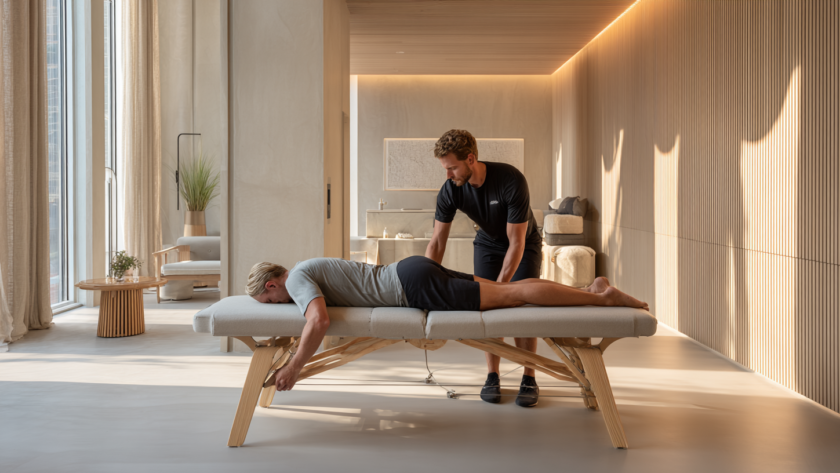
That distinction is becoming commercially meaningful. Practitioner-assisted stretching has moved from physical therapy, athletic training and rehabilitation settings into dedicated consumer studios built around recurring appointments and memberships.
The footprint is already substantial. Stretch Zone operates more than 420 locations, while competitor StretchLab operates more than 500 studios across North America, according to company executives interviewed by Forbes in February 2026.
More recently, a July 2026 Health article positioned assisted stretching within the healthy-aging conversation, connecting mobility with the ability to keep performing ordinary activities later in life.
The underlying behavior makes sense.
Mobility is easy to ignore until it becomes difficult.
The business question is harder:
Can assisted stretching become a durable recurring wellness category when consumers can stretch at home for free?
The answer depends less on whether stretching works at all than on whether professional assistance creates enough additional value to sustain repeat behavior.
From Exercise Component to Standalone Service
Stretching traditionally lives inside something else.
It happens before exercise, after exercise, during rehabilitation, in yoga, in physical therapy or as part of an individual mobility routine.
Specialized stretching studios separate that activity from the surrounding experience and sell it as the primary product.
That changes the competitive set.
Assisted-stretching businesses are not competing only against one another. They compete with:
- Self-directed stretching
- Personal trainers
- Physical therapy
- Massage
- Yoga and Pilates
- Mobility programs
- Strength training
- Recovery services
- Doing nothing
This matters because a new wellness category does not become durable simply because the underlying activity is useful.
It becomes durable when consumers understand why they should repeatedly pay for this particular version of it.
The Evidence for Stretching Is Stronger Than the Evidence for the Business Model
There is good evidence that stretching can increase range of motion.
A 2023 systematic review and meta-analysis of 47 studies found that a single stretching session produced a small improvement in range of motion compared with inactive controls. The analysis did not find one stretching technique consistently superior across the conditions studied.
Longer-term research also supports improvements in range of motion from repeated stretching. But stretching is not the only route to greater mobility. A systematic review comparing strength training with stretching found no statistically significant difference between the two approaches in improving range of motion across the studies examined.
That is an important commercial distinction.
The scientific question—
Can stretching improve flexibility and range of motion?
—is relatively straightforward.
The category question—
Does practitioner-assisted stretching create enough incremental benefit to justify an ongoing paid service?
—is much less settled.
Stretch Zone Is Beginning to Test That Question
Stretch Zone published a company-supported study in 2026 examining its standardized practitioner-assisted stretching method.
The prospective cohort included 32 adults divided among four conditions over four weeks, including different session frequencies and durations and a no-stretching control. Researchers measured 35 range-of-motion variables at baseline, after the program and again 30 days later.
The study reported improvements across most of the range-of-motion measurements, with the largest gains among participants receiving two 60-minute sessions per week. Many of the improvements remained measurable at the 30-day follow-up.
Those findings are useful.
They are not definitive.
Stretch Zone funded the research. Its president and CEO, Tony Zaccario, and founder, Jorden Gold, are study authors. The paper itself acknowledges that larger randomized comparisons with self-directed stretching and other interventions are still needed, along with longer-term and cost-effectiveness research.
That limitation does not make the research irrelevant.
It makes the next question clearer.
If assisted-stretching businesses want to expand from an appealing wellness experience into a durable category, they will need increasingly strong evidence about what professional assistance adds.
The First Session Is Probably the Easy Part
Assisted stretching has one commercial advantage that many preventive-health behaviors lack:
The consumer may feel something immediately.
A guided session can create an obvious contrast between how someone moved before and after the experience. A recent Health account described precisely that kind of immediate perceived difference after a Stretch Zone session, while also noting that short-term effects require continued activity to maintain.
That can be powerful for trial.
But trial and retention are different problems.
The first visit can sell:
“I feel looser.”
A recurring membership eventually has to answer:
“Why should I keep paying for this?”
That moves the business from experience design into evidence, habit and perceived progress.
The Assisted Stretching Adoption Loop
A durable category likely needs five things to happen in sequence.
| Stage | Consumer question | Commercial requirement |
|---|---|---|
| Need | Why does mobility matter to me? | Make the problem personally relevant |
| Experience | Do I feel a meaningful difference? | Deliver an observable first-session benefit |
| Proof | Am I actually improving? | Make progress understandable and credible |
| Repeat | Why do I need another session? | Establish the role of continued participation |
| Integration | Where does this fit in my health routine? | Become complementary to fitness, recovery and healthy aging |
The weakness of any one stage can interrupt recurring behavior.
That makes category education unusually important.
Mobility May Be a Stronger Category Than Flexibility
“Flexibility” can sound optional.
“Mobility” is easier to connect to everyday capability.
Getting out of a chair.
Reaching overhead.
Turning comfortably.
Playing a sport.
Traveling.
Working without persistent stiffness.
Keeping up with children or grandchildren.
Remaining physically independent later in life.
That creates a natural connection with the broader shift from fitness toward healthspan and functional capability.
But there is an important boundary.
Mobility is only one component of long-term physical function.
Strength, cardiovascular capacity, balance and power also matter substantially as people age. Assisted stretching should therefore not be positioned as a substitute for comprehensive physical activity or medical rehabilitation when those are needed.
The stronger category opportunity is complementary:
mobility as a recurring component of maintaining physical capability.
Healthy Aging Expands the Addressable Audience
The growth of longevity and healthy-aging interest creates another opportunity for the category.
Consumers increasingly think about health not simply as avoiding disease, but as preserving the ability to live independently and participate in desired activities for longer.
That shift is central to the distinction between lifespan and healthspan.
Assisted stretching fits naturally into that conversation because mobility has intuitive relevance across age groups.
But attaching the word “longevity” to stretching does not prove that stretching extends life.
The scientifically responsible proposition is narrower and more useful:
Maintaining range of motion can support movement and physical function, while mobility exists alongside strength, balance, aerobic fitness and other determinants of healthy aging.
That is enough to create a meaningful consumer proposition without asking the science to carry more than it supports.
The Category Has a Differentiation Problem
If assisted stretching continues growing, operators will face another problem:
The service itself is relatively easy for consumers to describe.
One person stretches another person.
That simplicity is an advantage when explaining the category.
It is a disadvantage when trying to explain why one provider is meaningfully different from another—or why the customer should pay rather than stretch independently.
Companies therefore need differentiation beyond the generic service.
Potential sources include:
Method
A clearly defined protocol can make the experience more consistent and defensible.
Practitioner Quality
The consumer is buying human judgment as much as physical assistance. Training standards and consistency therefore become part of the product.
Measurement
Showing changes in mobility or range of motion can turn a subjective feeling into visible progress.
Personalization
A program tied to individual limitations, activities and goals is easier to value than a generic stretch.
Continuity
A practitioner who understands how someone moves over time can create switching costs that a one-off session cannot.
Integration
Partnerships with fitness, rehabilitation, sports, employers or healthy-aging programs can make stretching part of a broader health system rather than an isolated service.
These are business-model questions as much as wellness questions.
Scale Changes the Question
Stretch Zone and StretchLab together now represent hundreds of specialized studios. That is meaningful evidence of consumer and franchise interest, although store count alone cannot establish long-term category economics.
As the category grows, the question changes.
Early-stage operators must prove:
Will people try this?
Scaled operators increasingly need to prove:
Will enough people stay?
That makes several metrics more strategically important than awareness alone:
- Repeat visits
- Membership conversion
- Membership duration
- Visit frequency
- Referral behavior
- Customer outcomes
- Perceived progress
- Reasons for cancellation
- Differences among customer segments
The next competitive advantage may therefore come less from opening another studio than from understanding which consumers develop a lasting assisted-stretching habit and why.
Evidence Can Become Part of the Product
Stretch Zone’s investment in research is notable for another reason.
In a fragmented wellness market, evidence can do more than support claims.
It can help define a category.
Consumers may understand what massage is.
They understand what physical therapy is.
They understand what a personal trainer does.
Assisted stretching still requires more explanation.
Research can help operators establish:
- What outcomes the service reliably influences
- Who is most likely to benefit
- How frequently participation matters
- Which benefits persist
- How assisted stretching compares with alternatives
- Where the service belongs within a broader health routine
That creates both scientific and commercial value.
But it only works if companies remain disciplined about the difference between evidence and promotion.
As discussed in Evidence vs. Hype in Wellness, credibility becomes especially important when an emerging category asks consumers to make recurring health investments.
Overstatement may accelerate attention.
It can also weaken the trust the category needs to mature.
The Category Opportunity Is Real. Its Definition Is Still Developing.
Assisted stretching has moved considerably beyond a niche athletic service.
Large studio networks, franchise investment, recurring memberships and growing healthy-aging attention all suggest that businesses are successfully creating demand around professional mobility services.
The remaining challenge is not simply convincing consumers that stretching can feel good.
It is proving where professional assistance creates enough additional value to deserve a recurring place in someone’s health routine.
That will require more than store growth.
It will require stronger comparative evidence, clearer customer segmentation, meaningful measurement and a better understanding of what causes trial to become habit.
That is how a service becomes a category.
Building a wellness service people will try once—but need to choose repeatedly? We help teams understand what drives adoption, retention and category preference before the next stage of growth. Email Us.
Sources
All source links below were verified during preparation of this article.
- Forbes — Why Stretch Zone Is Opening a Store Every Week in 2026
https://www.forbes.com/sites/sharonedelson/2026/02/10/stretch-zone-expands-with-new-locations/ - Journal of Musculoskeletal Disorders and Treatment — The Stretch Zone Effect
https://clinmedjournals.org/articles/jmdt/journal-of-musculoskeletal-disorders-and-treatment-jmdt-11-134.php - Sports Medicine – Open — Acute Effects of Various Stretching Techniques on Range of Motion: A Systematic Review with Meta-Analysis
https://link.springer.com/article/10.1186/s40798-023-00652-x - Healthcare — Strength Training versus Stretching for Improving Range of Motion: A Systematic Review and Meta-Analysis
https://www.mdpi.com/2227-9032/9/4/427 - Health — I Went to My First Stretch Session, and It Changed How I Think About Healthy Aging
https://www.health.com/stretching-for-longevity-12006815 - Stretch Zone — Industry-First Research Study
https://www.stretchzone.com/press/stretch-zone-research-study
Frequently Asked Questions
What is assisted stretching?
Assisted stretching involves another person guiding the body through stretches rather than the individual performing them entirely independently. Commercial studios typically use trained practitioners, structured protocols and specialized equipment.
Does assisted stretching improve flexibility?
Stretching in general has strong evidence for improving range of motion both immediately and through repeated training. Early research specifically examining practitioner-assisted stretching also reports improvements, but that evidence base is much smaller.
Is assisted stretching better than stretching by yourself?
There is not yet enough high-quality comparative research to conclude that practitioner-assisted stretching is generally superior to well-designed self-directed stretching. Professional assistance may offer advantages in guidance, consistency, personalization and adherence.
Is stretching important for healthy aging?
Maintaining adequate mobility can help people continue performing everyday movements and physical activities as they age. Mobility should be considered alongside strength, balance, cardiovascular fitness and other components of physical function.
Does assisted stretching increase longevity?
There is no evidence that assisted stretching itself extends lifespan. Its more credible connection to healthy aging is through mobility, movement and physical function.
How often do people need assisted stretching?
The optimal frequency is not firmly established and will depend on goals, health status and other physical activity. Stretch Zone’s small 2026 study found larger range-of-motion improvements in its highest-frequency group, but broader independent research is still needed.
Is assisted stretching the same as physical therapy?
No. Physical therapy is healthcare delivered by licensed professionals to assess and treat specific conditions and impairments. Commercial assisted-stretching services generally operate as wellness or fitness services and should not be assumed to replace medically indicated rehabilitation.
Why are assisted-stretching studios growing?
The model turns mobility into a dedicated consumer service with professional guidance, scheduled participation and a relatively easy-to-understand experience. Large franchise networks suggest meaningful consumer interest, although continued growth will depend on retention and sustainable unit economics.
What is the biggest challenge for the assisted-stretching industry?
The category must demonstrate why consumers should repeatedly pay for professional stretching when lower-cost alternatives exist. Evidence, personalization, measurable progress and habit formation are therefore likely to become increasingly important.
What could make assisted stretching a durable wellness category?
Durability will depend on whether providers can consistently connect the experience to meaningful consumer needs, demonstrate progress, establish repeat behavior and integrate mobility into broader fitness and healthy-aging routines.